DINOSAUR FUN

I don’t know about anyone else out there but we have a number of budding palaeontologists at playschool! They absolutely love learning about dinosaurs and are fascinated by all the different types. In this post I’ve included some of our ideas to inspire and encourage creative discussions about dinosaurs. I tried to fill our space with different provocations all over the show – from bigger floor space play areas to tiny cubby spaces – the children loved discovering little surprises all over the show!

Somedays we would have a lush dinosaur jungle filled with dangerous dinosaurs! I made my own rocks and caves using filla foam from the hardware store. I’ve included more on how to make these in another post.

On another day we would have a rocky outcrop filled with caves, volcanoes and waterfalls…

On another just a big floor space filled with different levels and loose parts to get creative.

There was great fun as the children searched for dinosaur “fossils” buried under the sand. They had their own mini spoons and paintbrushes to dig around and discover. (I’ve since done this activity with kinetic sand and I don’t even have to tell you how mesmerising this was!)

The highlight of the week is always a simple volcano experiment. So simple and so much fun. The children will do this over and over taking turns – their delight is contagious…

I just love dinosaur week – the enthusiasm and excitement is paramount!

FREE RESOURCES:

dinosaur resources01 dinosaur resources02 dinosaur resources03 dinosaur resources04

DINOSAUR FUN

AUTUMN

There are so many lovely creative activities for children to do in Autumn. The seasons are changing and the air is crisp and fresh…They start arriving in warmer clothes and we bundle up before we go outdoors. We don’t need an excuse for warm tea and biscuits! Even though the weather starts restricting our outdoor activity at times – there is no shortage of energy and enthusiasm!

I’ve included a few displays in this post for Autumn inspiration! On our theme table we had miniature Autumn leaves with pine needle brooms and Autumn creatures. The children spent ages sweeping up the leaves and making “nests” and “warm beds” for the animals. We even painted with our home made brushes as the week progressed.

On the other side of the class we had an Autumn felt board that had the children riveted in long periods of avid story telling and re-organising!

Outside we had various areas with bundles of Autumn finds – as the week progressed every one’s treasures and finds got added to the piles. Each day there were little “creatures” and “insects” hidden among the leaves, pinecones and needles waiting to be found and played with.

We loved playing with the projector and experimenting with all our finds. Playing with light, shadow and colours kept everyone busy for ages. There were so many different items to explore and discover. The children even played at being “Autumn” leaves as they danced amongst the shadows!

AUTUMN

PROJECT – VERSATILE ACTIVITY BOARDS

I don’t have much free wall space in our class – so what I do have available has to be utilised really well. I knew I wanted a felt board as I have lots of felt resources I’ve made over the years to let the children make their own stories and use them in story telling during circle times. I also wanted an activity board…and a chalk board! Oh boy…

So we came up with a way to incorporate all 3 into the space I had available for them with a series of boards that I can easily change on the wall. The easiest to make was the chalk and felt boards and these make use of the same board back to back. The activity board was a little more complicated and patient husband pretty much put that one together for me.

Items we used: wood for frame; thin board for inside frame; blackboard paint; glue gun; wall screws; hooks; felt; board for activity board; various second hand items for activity board.

The chalk/feltboard was relatively easy to make. Besides the time for the paint to dry it’s also a quick project. We found an old frame that I painted on one side and attached the felt to the other with a glue gun. Patient husband attached the screw to the wall and hooks to the board and thats it!

The activity board was a little more complicated and took a few days  weeks months to make. The most time consuming part is gathering all the items you are going to put on the board. We went to a car boot sale market and sourced most of the items there – otherwise the board will end up costing you a fortune. It’s also quite difficult to attach the items to the board securely – patient husband helped with this as you need to be handy with a number of tools to make holes, screws and rings to secure at the back and sanders to smooth off edges.

The boards are great – I use them all the time and am constantly changing their original purpose to suit the occasion! Sometimes the children paint with thin paint brushes and water on the chalk board, draw with thin and fat chalks etc. The activity board is a great hit and the children will turn it into whatever they are currently into – race car, fire engine, aeroplane or just an activity board!

PROJECT – VERSATILE ACTIVITY BOARDS

LOOSE PARTS

I consider having plenty of loose parts available at all times for play one of the most important things at school. There are so many different types, sizes, uses – the list is endless! I’m constantly on the look out for new loose parts to add to our collection at school. I love natural loose parts but I definitely feel there is a place for synthetic loose parts as well.

I like to swop in and out with different items so that there is plenty to inspire play, teamwork and interaction. One of my best buys was a set of large pvc covered colourful shapes. These are always outside and available for construction and building – whether the children are building castles, shops, firetrucks, you name it, there is a constant hive of activity as they move, build and climb. They are fantastic for developing body awareness and movement. In the past I have also provided plastic crates for holding bottles (a LOT of them!) – these are fantastic as they clip into each other and the children can actually construct whole play scenes for themselves.

In the summer months the loose parts are stored in large garden pots in a wooden frame (actually an old sandpit frame) that is often turned into some creative vessel or other. Other great items we love are: various ropes of different length and texture; pinecones; curtain rings; pegs; gutter piping and all the varying joining bits; plastic balls; pebbles in the dry creek bed – the list can be endless!

LOOSE PARTS

PROJECT – WOODEN FENCES

I’ve always seen wonderful wooden fences in gorgeous school blogs and never been able to find them. As a substitute I’ve tried plastic fences – but lets face it they just fall over and cause endless frustration! To have sturdy wooden fences would be awesome right? So after having the wood lying around for days weeks patient husband pandered my whims and made me a whole box of wooden fences – bliss!

Items we used: long squared piece of wood (25mm x 25mm), dowling rod (your pick of thickness – thicker the sturdier), sander, glue gun

Basically just cut the fence ends into equal lengths (mine are just over 10cm) and sand the edges so that they are not sharp. Cut the dowling rod into equal lenths. Measure and and drill holes into wooden sides and attach dowling into holes with extra glue to secure. Your measurements need to be quite acurate to ensure the fences actually stand. We applied a non toxic wood sealant to ours – optional. If you are unable to make your own get in touch with me to buy a batch – smallschoollove@gmail.com…

The great thing about wooden fences is that they can be used for all sorts of smaller loose part play provocations. They also stand on most surfaces (you can see they even stand on our grass carpet). I use them indoors and outdoors and the children spend ages incorporating them into their play.

PROJECT – WOODEN FENCES

ACTIVITY – GIANT COLOUR ICE BALLS

Every one loves giant ice balls right?! I make ice balls a few times a year and adapt it to suit the theme or whatever is trending at play school! The children love water whatever the weather and this is a nice extra dimension that really gets the conversation flowing…

Items you need: balloons; food colouring; syringe; water; patience

For this batch our theme for the week had been colours. We had been having a stretch of particularly hot weather so the giant ice balls suited the occasion perfectly! The initial reaction had been delight coupled with a lot of shrieking and shivering – they were freezing! As the children got braver they held them, rolled them and passed them around – all the while chatting and expressing their findings. They loved holding them and studying the beautiful bubble designs.

As the ice balls started melting the colours started to mix and this provided a further opportunity to discuss the different colours and what was happening. For other themes I have frozen plastic insects, dinosaur fossils, glitter, beads etc. This is an activity that needs to be closely supervised.

ACTIVITY – GIANT COLOUR ICE BALLS

PROJECT – MUD PIE KITCHEN

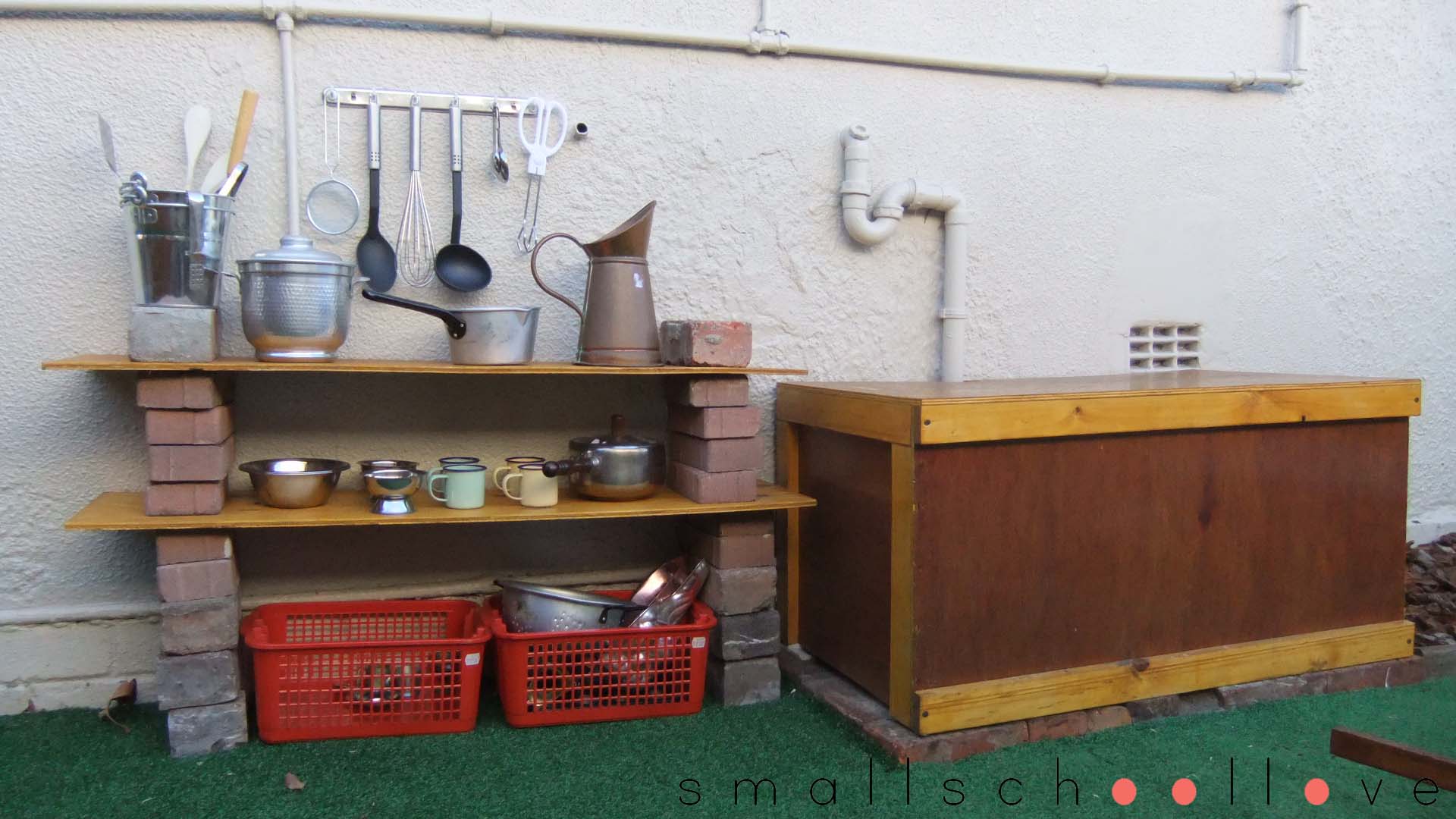
Every school home with children should have an outdoor mud pie kitchen! Some of my clearest memories growing up are of mixing mud, water, sand and leaves to make “food”, “potions” and “medicine”! As an only child I could spend hours on my own concocting and mixing quite content in the sun or rain…

At school I’ve found our mud pie kitchen to be the hub most outdoor days. It’s a hive of activity as the children chat, share, laugh and invent their own recipes. Situated next to the sandpit and dry creek bed it soon turns into a vibrant chaotic sandy stony mess delightful play space!

Items we used: wood to make box table and shelves; bricks; stainless steel hanging hooks; assorted pots, pans, cups, spoons etc.

outdoor kitchen

Our kitchen is SO basic – just proving you don’t need to spend a fortune or have any major building ability to make your own outdoor kitchen. Most often the pots and pans end up in the sandpit or creek bed and thats fine! I’m always popping into second hand shops and browsing the pots and pans, bowls and spoons to add to the mix of equipment available. Great items to include are: tongs, funnels, sieves and measuring spoons. Nearly all the equipments encourages great fine motor development and concentration.

The children spend ages socialising and discussing their actions – I can just sit for ages listening to their animated conversation and delighting in their focused dedication to their task! Water, sand, pebbles, grass and scented herbs all come together in a frenzy of happy cooking!

PROJECT – MUD PIE KITCHEN

PROJECT – MINIATURE WOODEN TREEHOUSE

This was an easy project and something I use so often – my first inexperienced attempt to make a miniature treehouse!…There are some really gorgeous pictures online as inspiration – it totally depends on your level of wood working skill and the tools you have available to use. I’m constantly using them in play provocations for the children with varying loose parts and am always excited when I see the reactions and outcomes.

Items we used: sanded non-toxic wood in varying size and shape; sand paper; glue gun; drill and screws.

The hardest part is finding the correct pieces of wood. We had cut down a number of trees in our garden the previous year and after checking they were non toxic species had stored them to dry for a number of months. Alternately find a saw mill that is able to sell/donate you off cuts. Along with some larger wood rings we used for the base and platforms from a saw mill, we had enough to start assembling and figuring out how everything was going to fit together.

The process was largely trial and error. The pieces all had to be sanded and smoothed to ensure no splinters could make their way into little fingers – although I didn’t want it to have too much of a “finished” look. (You can achieve this by de-barking your wood and applying beeswax sealant or coconut oil to it). I wanted it to be quite high in relation to the children to encourage play on different levels. Patient husband put the main screws in the base and larger branches and platforms that formed the basic structure. Once these were in place we pretty much played around with the smaller rings creating steps to the various platforms.

We used the left overs to make other smaller wooden elements for play. The process was really fun and has since then inspired me to make many more basic wooden play “landscapes” for the children to use. They really love the natural solid comforting texture of the wood and spend ages adapting the materials to suit their creative moods.


PROJECT – MINIATURE WOODEN TREEHOUSE