PROJECT – WOODEN FENCES

I’ve always seen wonderful wooden fences in gorgeous school blogs and never been able to find them. As a substitute I’ve tried plastic fences – but lets face it they just fall over and cause endless frustration! To have sturdy wooden fences would be awesome right? So after having the wood lying around for days weeks patient husband pandered my whims and made me a whole box of wooden fences – bliss!

Items we used: long squared piece of wood (25mm x 25mm), dowling rod (your pick of thickness – thicker the sturdier), sander, glue gun

Basically just cut the fence ends into equal lengths (mine are just over 10cm) and sand the edges so that they are not sharp. Cut the dowling rod into equal lenths. Measure and and drill holes into wooden sides and attach dowling into holes with extra glue to secure. Your measurements need to be quite acurate to ensure the fences actually stand. We applied a non toxic wood sealant to ours – optional. If you are unable to make your own get in touch with me to buy a batch – smallschoollove@gmail.com…

The great thing about wooden fences is that they can be used for all sorts of smaller loose part play provocations. They also stand on most surfaces (you can see they even stand on our grass carpet). I use them indoors and outdoors and the children spend ages incorporating them into their play.

PROJECT – WOODEN FENCES

PROJECT – MUD PIE KITCHEN

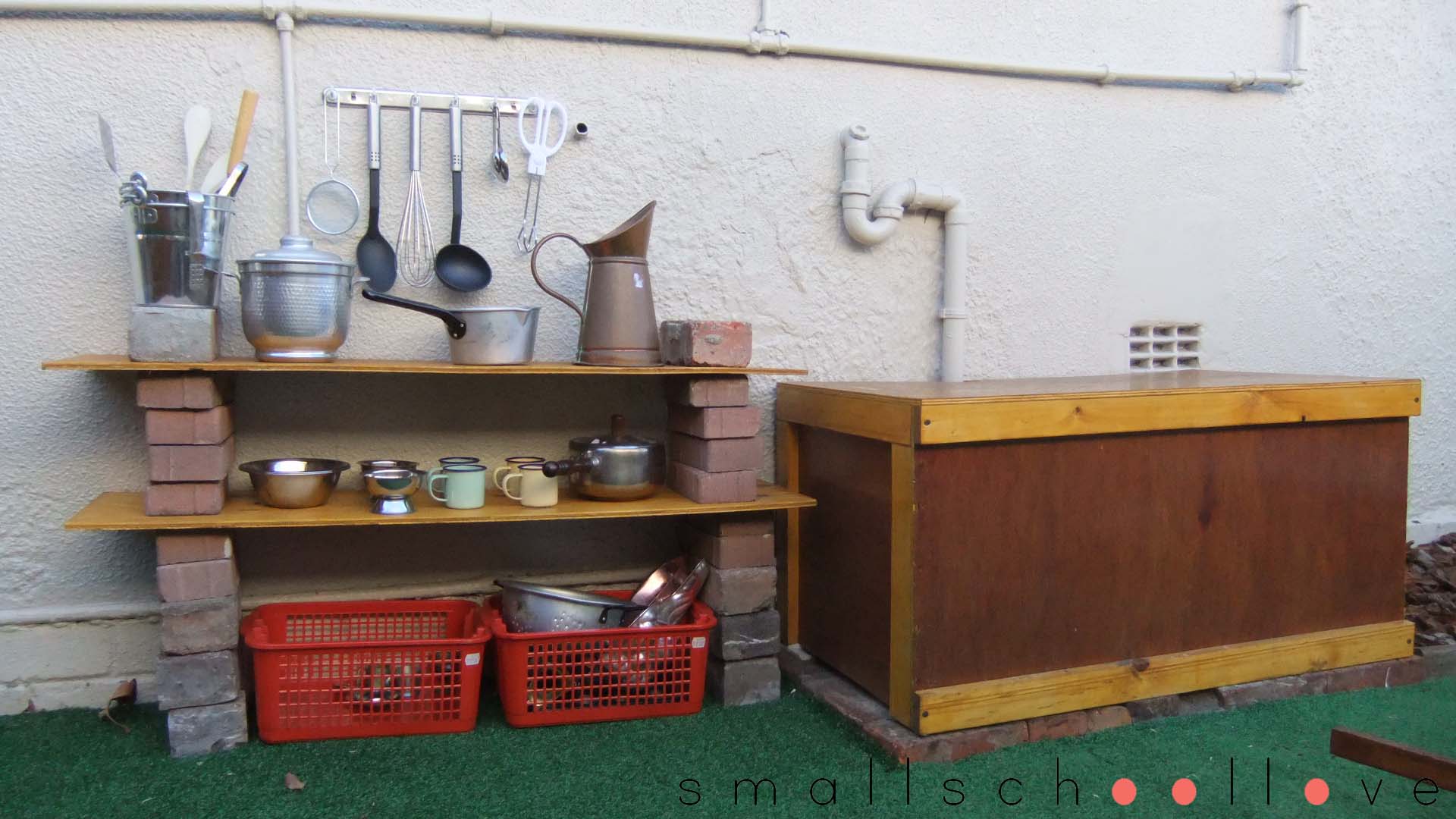
Every school home with children should have an outdoor mud pie kitchen! Some of my clearest memories growing up are of mixing mud, water, sand and leaves to make “food”, “potions” and “medicine”! As an only child I could spend hours on my own concocting and mixing quite content in the sun or rain…

At school I’ve found our mud pie kitchen to be the hub most outdoor days. It’s a hive of activity as the children chat, share, laugh and invent their own recipes. Situated next to the sandpit and dry creek bed it soon turns into a vibrant chaotic sandy stony mess delightful play space!

Items we used: wood to make box table and shelves; bricks; stainless steel hanging hooks; assorted pots, pans, cups, spoons etc.

outdoor kitchen

Our kitchen is SO basic – just proving you don’t need to spend a fortune or have any major building ability to make your own outdoor kitchen. Most often the pots and pans end up in the sandpit or creek bed and thats fine! I’m always popping into second hand shops and browsing the pots and pans, bowls and spoons to add to the mix of equipment available. Great items to include are: tongs, funnels, sieves and measuring spoons. Nearly all the equipments encourages great fine motor development and concentration.

The children spend ages socialising and discussing their actions – I can just sit for ages listening to their animated conversation and delighting in their focused dedication to their task! Water, sand, pebbles, grass and scented herbs all come together in a frenzy of happy cooking!

PROJECT – MUD PIE KITCHEN

PROJECT – MINIATURE WOODEN TREEHOUSE

This was an easy project and something I use so often – my first inexperienced attempt to make a miniature treehouse!…There are some really gorgeous pictures online as inspiration – it totally depends on your level of wood working skill and the tools you have available to use. I’m constantly using them in play provocations for the children with varying loose parts and am always excited when I see the reactions and outcomes.

Items we used: sanded non-toxic wood in varying size and shape; sand paper; glue gun; drill and screws.

The hardest part is finding the correct pieces of wood. We had cut down a number of trees in our garden the previous year and after checking they were non toxic species had stored them to dry for a number of months. Alternately find a saw mill that is able to sell/donate you off cuts. Along with some larger wood rings we used for the base and platforms from a saw mill, we had enough to start assembling and figuring out how everything was going to fit together.

The process was largely trial and error. The pieces all had to be sanded and smoothed to ensure no splinters could make their way into little fingers – although I didn’t want it to have too much of a “finished” look. (You can achieve this by de-barking your wood and applying beeswax sealant or coconut oil to it). I wanted it to be quite high in relation to the children to encourage play on different levels. Patient husband put the main screws in the base and larger branches and platforms that formed the basic structure. Once these were in place we pretty much played around with the smaller rings creating steps to the various platforms.

We used the left overs to make other smaller wooden elements for play. The process was really fun and has since then inspired me to make many more basic wooden play “landscapes” for the children to use. They really love the natural solid comforting texture of the wood and spend ages adapting the materials to suit their creative moods.


PROJECT – MINIATURE WOODEN TREEHOUSE

DRY CREEK BED

I’ve always wanted a dry creek bed as a play space – but actually making one seemed like an impossible task! Luckily patient husband sat through my drawings and endless pictures and helped come up with a very basic creek bed design to fit our small space. It is one of the children’s favourite spaces to come and you will always find someone sorting, counting, mixing, exploring textures, chatting, balancing or even just having a quiet reflective moment.

The end product was pretty spot on to the vision and drawings I made and even though it’s a “small” creek bed it has actually made the space intimately socially interactive and led the children to be mindful and patient of each other moving around it. As it was arranged against a wall I decided on a half circle design with an “island” in the middle. The island has a little bridge with a small TP on it.

Things we used: Large rocks for creek bed border; thick plastic to line creek bed; malleable plastic mesh for inside cement; cement mix; assorted stones and pebbles to place in cement to set and to fill creek bed.

We were lucky that we had a parking space to clear and sourced a number of larger rocks that formed the basic shape of the creek. We also dug the shape on a slight incline so that if I wanted to put fresh water into the pond side of the creek to splash around in I could. Once the basic shape was dug out we could figure out where the rocks could be placed.

The next bit was a little trickier – I’d advise you get someone with a basic knowledge of cement and its processes to help you out – luckily patient husband was hands on and had a grasp of exactly what I had in mind! To start with he laid plastic in the furrowed out creek bed (best to use a thickish plastic) and then he laid a malleable plastic mesh on the plastic. He then mixed up the cement and spaded and patted it into the creek shape. Once we had the basic shape we arranged a variety of stones and pebbles (the rounded type) into the cement. Although this was time consuming it definitely gives the creek bed a more authentic feel and adds a great textural quality as opposed to plain cement.

And thats IT!! After roughly one week the cement was set and we could place the loose stones and pebbles in the creek bed. Guaranteed the pebbles end up all over the school and it is a maintenance play space, but despite this it is one of the children’s favourite play spaces and totally worth the effort. Unfortunately we don’t get any natural “creatures” inhabiting our creek bed so I will regularly hide plastic frogs, insects, fish, mice etc in the nooks and crannies around the creek. Coupled with some buckets and small fish nets they will spend ages together exploring, catching and chatting about their adventures.

DRY CREEK BED